
 Over the last 24 games of the 2012 season, Muhlenberg second baseman Chris Manfredonia hit .320, raising his average from .260 to .299.
A solid end to a promising first season of collegiate baseball, especially for someone who missed most of his senior season in high school due to a back injury, but nothing extraordinary.
Except for the fact that Manfredonia had at least one hit in each of those 24 games.
Manfredonia broke a 25-year-old school record for longest hitting streak. But the streak was so inconspicuous that it flew under even his own radar until he surpassed the previous mark of 17 games in the second game of the Gettysburg doubleheader.
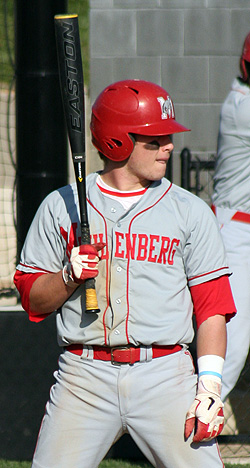 “After the Gettysburg game a couple of guys came up to me and told me that I broke the record for longest hitting streak,” said Manfredonia. “I thought they were joking.”
Manfredonia had exactly one hit in 18 of the 24 games. In 15 of the 24 games, his first hit came in the sixth inning or later – including the record-breaking single against Gettysburg, which came on a two-strike pitch in the ninth. That was one of five ninth-inning streak-extenders.
True to form, Manfredonia made sure his streak would carry over into 2013 by going 1-for-6 in each game of Sunday’s season-ending twinbill vs. Johns Hopkins. He beat out a slow roller to third with the bases loaded in the eighth inning of the opener and went opposite field for his only double of the season in the sixth inning of Game 2.
By comparison, Kelly Kline of the Muhlenberg softball team had a school-record 25-game hitting streak this season in which she batted .512. Joe DiMaggio hit .406 in his Major League Baseball-record 56-game streak in 1941.
This wasn’t so much “Joltin’ Joe” as it was “Consistent Chris.”
“I just try to not get too low, stay on an even keel and play the game with a consistent approach,” said Manfredonia.
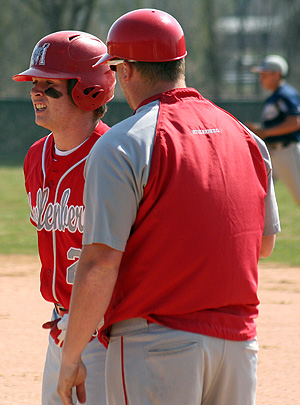 Of course, you can’t get hits without putting the ball in play, and Manfredonia did plenty of that. He struck out 10 times in his 50 pre-streak at-bats but whiffed only 11 times in 97 at-bats during the streak.
“I was striking out a little more early in the year than I would have liked,” he said. “So I tried to get fastballs early in the count, make hard contact and put the ball in play.”
A big Yankees fan, Manfredonia gained a new appreciation for DiMaggio’s streak, which would take almost another full year for him to approach.
“In the Major Leagues you play every single day; here you play only four days a week,” he said. “It’s hard to stay healthy to be able to hit in 56 straight games, and you have to get lucky once in a while. I can’t even imagine doing that.”
One of the ironies of Manfredonia’s record streak is that before it got going, he was on his way to a different school record. He had six sacrifices, one short of the record, halfway through the season, but as the hits kept coming and he moved up in the order, the bunt sign stopped coming. Another unfortunate irony is that most of his streak coincided with a team losing streak that turned the program’s best start in 84 years into a 19-21 final record.
So would Manfredonia, the would-be king of sacrifices turned king of hitting streaks, be willing to sacrifice his streak for a few more wins next year?
“Any day!” he said.