
 Muhlenberg track and field coach Brad Hackett never planned on writing a book. But after 30 years of coaching, there were just so many stories to tell.
With If All I Had To Do Was Coach, Hackett gives readers a glimpse into the always-interesting life of a track and field coach. The first of many unforgettable anecdotes littered throughout Hackett’s first book gave him the nudge he needed to do something he never thought he would.
In 1993, when Hackett was in the middle of his nearly 10 years as an assistant coach at Syracuse, the school was set to host the high school national indoor championships. More than 1,500 athletes from all 50 states descended upon the Carrier Dome on a frozen March day. Soon, they would have nowhere to go.
 An almost unthinkable 54 inches of snow fell in a 24-hour span, sending the city into a state of emergency and trapping more than 5,000 people into the field house. The roof of the Carrier Dome was let down before the governors of Rhode Island and New York and the National Guard got involved, and somehow the meet was able to go off. After that, Hackett had the story that started it all.
“That was the beginning,” said Hackett, who has coached at Muhlenberg since 1999. “People kept on saying, ‘oh, you were around and you never slept for 72 hours. Think of all the things that happened; you could write a book about that,’” Hackett recalled. “So I ended up turning that into a chapter of the book.”
The rest of Hackett’s story, however, took many years to come out. By the time he left Syracuse in 1997, Hackett had written four or five chapters of the book, but he let it sit in an envelope for more than a decade. Coincidentally, another trip to upstate New York was all he needed to dive back in.
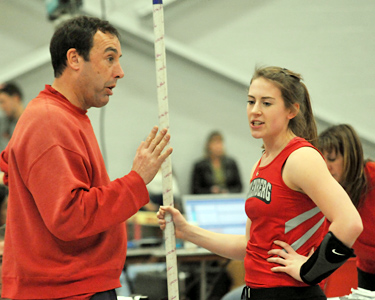
Hackett has coached more than 50 Centennial Conference gold medalists, including pole vaulter Erin Saucier.
With his wife at Colgate’s 25th college reunion in 2008, Hackett looked around and saw accomplished, wildly successful classmates everywhere he looked. Bob Woodruff, the television news anchor. Austin Murphy, a well-known writer for Sports Illustrated. And don’t forget SportsCenter anchor David Lloyd.
“On the way home, I said to my wife, ‘look what these people have done. What have I done?’” Hackett recalled. “That was the impetus to get the ball rolling again and finish it.”
After that, the stories came flowing out of his pen. He finished the writing process in a mere three or four months that summer.
“I started to realize I had had seven or eight incidents driving a van coming home from a meet, six or seven incidents with a bad hotel or a bunch of really interesting characters or kids that have done bizarre things,” Hackett said. “I started putting it into an outline of categories, and from there it became apparent that was the style I was going to go with. It was as if I’m sitting in a bar telling people a bunch of different stories.”
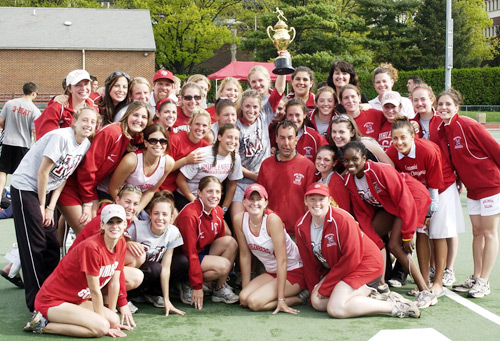
Hackett coached the women’s track and field team to a Centennial Conference championship in 2005.
After the writing process was complete, it was a matter of finding the right person to publish it. At first, the book was met with skepticism or outright rejection, but another stroke of good fortune set everything in motion.
Hackett was speaking at a clinic hosted by a good friend, who happened to be a friend of the owner of Coaches Choice Publishing. The company liked what Hackett had to say, and the partnership was born. After several years of back-and-forth exchanges, the book’s editor got involved this summer, opening Hackett’s eyes to the rigors of publishing a book.
“The writing of it was easy,” Hackett said. “It was a narrative…I had told every one of those stories a million times. The interesting part to me was the final stage, the editorial process.
“I made an assumption that an editor of a book is making grammatical changes, and nothing could be farther from the truth. She went through every story with a fine-tooth comb.”
Hackett recalls hosting recruits at Syracuse on the night of the 1996 NCAA basketball championship between the Orange and Kentucky. The way Hackett remembered it, all five of Syracuse’s starters in that game were drafted into the NBA the following year. Not so, said his editor. Further research revealed that not all of those players were drafted. After other investigations, Hackett had a perfectly accurate product.
“That was the part that amazed me, the level of investigating my editor did to verify that everything I was saying was accurate,” Hackett said.
Hackett isn’t exactly a writing neophyte. He had published articles in track and field technical magazines. He enjoyed coming up with a premise and attempting to prove it, an early precursor to his first book. In If All I Had To Do Was Coach, Hackett hopes others in the track and field community will find stories that resonate with them, that remind them of similar experiences.
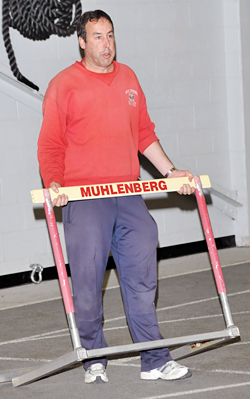
Moving hurdles is one of things Hackett has to do in addition to coaching.
“I look at this book as an opportunity for me to give back to the sport that has given me so much,” Hackett said. “I’m hoping some people that are not familiar with the sport – even though the book isn’t about track, it’s about a track and field coach – will have a little more of an understanding of what college coaching is like, and what coaching track and field is like, more specifically.
“If it’s popular enough within the coaching community that a lot of people read it, I would suspect that people would start to say to me, ‘hey, that story reminds me of something that happened to our team.’”
Despite its bevy of fascinating stories, Hackett says the beauty of the book is its commonality.
“I’ve got to believe that anyone who has been coaching as long as I have has encountered similar situations,” he said. “These stories could have happened to anybody.”
Now that he’s put those stories on paper, Hackett doesn’t plan on doing it again anytime soon. Still, it wasn’t something he expected to do the first time around. As any track and field coach can tell you, the stories never stop.
“I never dreamed,” Hackett said, “of doing something like this.”
If All I Had To Do Was Coach is available at the Colgate University and Muhlenberg College bookstores, as well as CoachesChoice.com, MFathletics.com, Venuesports.com, and Amazon.