In averaging 452 yards and 45 points through the first three games of the 2014 season, the Muhlenberg football team has shown great chemistry on offense: between the quarterback and receivers, between the running backs and offensive line, and between the linemen themselves.
It helps that two of the veteran starters on the line know a thing or two about chemistry.
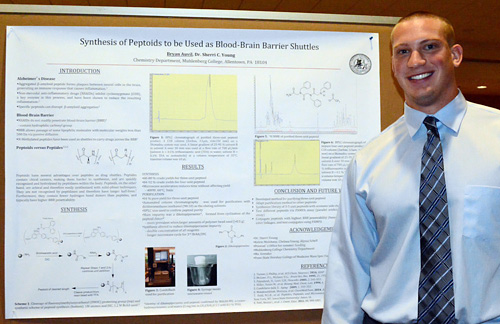
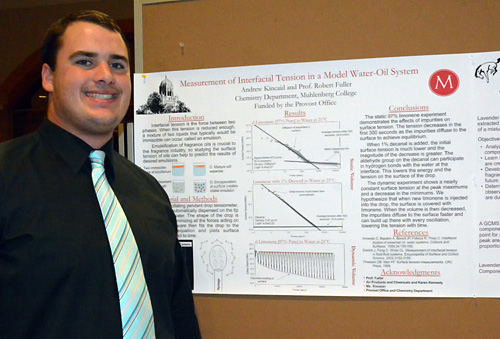
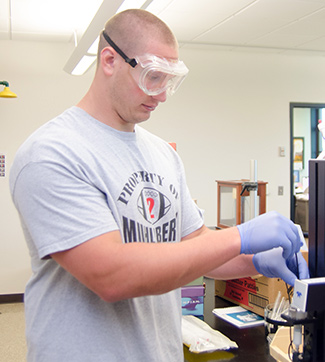
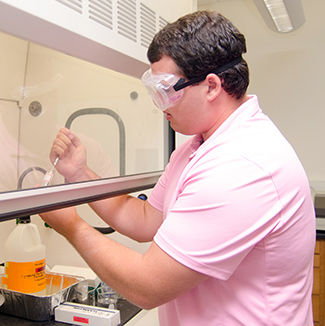
Juniors Bryan Auvil (right tackle) and Andrew Kincaid (center) are not only third-year starters on the offensive line, but they are both chemistry majors who spent this past summer doing research on campus. Both presented their projects at Muhlenberg’s Summer Research Poster Session last Friday.
“It was pretty awesome that we were both on campus doing research,” said Kincaid. “We got to work out together, and that definitely helped us prepare for the season.”
Auvil was mentored by Dr. Sherri Young for his project, “Synthesis of Peptoids to be Used as Blood-Brain Barrier Shuttles.” Here is how he described it:
 “Inflammation is a major cause of Alzheimer’s Disease and many other central nervous system (CNS) disorders. To date, there is no cure for AD, likely because drugs, called non-steroidal anti-inflammatory drugs (NSAIDs), which would be able to treat the inflammation, are unable to penetrate the blood-brain barrier, a membrane that prevents most molecules from entering the brain.
“The goal of our project is to modify NSAIDs to increase their membrane penetrability. We plan to do this by linking NSAIDs to small peptoids (similar to peptides) that should be able to act as a shuttle to carry the drug across the blood-brain barrier. I spent most of my summer developing a method to synthesize and purify these peptoids. “
 Kincaid worked with Dr. Robert Fuller on his project, titled “Measurement of Interfacial Tension in a Model Water-Oil System.”
“I studied the surface tension between the major component of orange oil and water,” he explained. “Learning about the surface tension of these oils allows us to make emulsions. Emulsions allow water and oils that usually shouldn’t mix to do exactly that. This is very useful in creating fragrances.”
Kincaid recalled that he and Auvil got plenty of comments about how different it was to have two football players in the lab during the summer. And by trading in their helmets and pads for goggles and lab coats, they may have lent credence to the notion that, because of the complex blocking schemes they have to learn, offensive linemen are among the smartest players on a football team.
“You can print that!” said Auvil with a laugh.
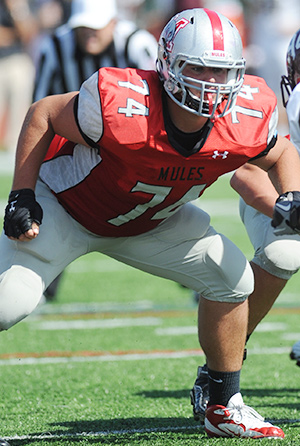 Kincaid (left) became very interested in his topic as he conducted his research and is continuing his studies this semester, taking a special course on the chemistry of fragrances. “I could definitely see myself getting into that field,” he said.
Auvil, meanwhile, plans to go to medical school and was happy to find an organic chemistry-type project that has a medical application.
Both Muhlenberg student-athletes relished the experienc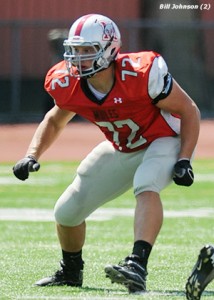 e as they do springing a back for a long run.
“The research is an awesome experience as an undergraduate, especially coming out of sophomore year,” said Auvil (right). “At larger schools, usually the graduate students do the research.”
“It’s awesome that we go to a place where we have all these opportunities,” added Kincaid. “To be able to do research in the summer and then play football in the fall … I’m pretty grateful for that.”